
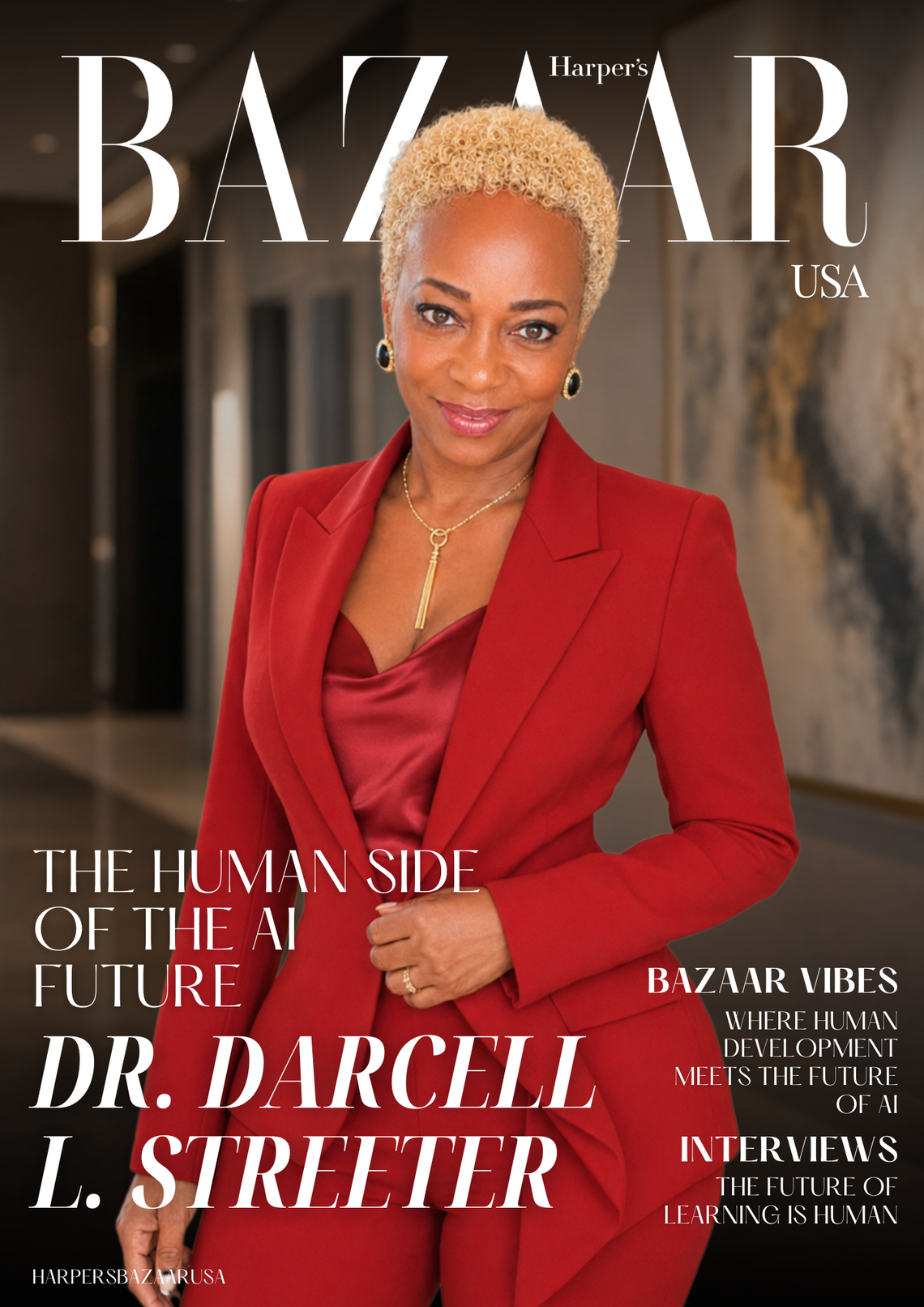
By Cory Sumner
There are careers that begin with a clear plan, and then there are careers that reveal themselves slowly, one experience at a time. For Dr. Darcell L. Streeter, the path began in a hospital emergency room, behind a front desk, long before she had the language to describe the work she would eventually spend decades pursuing.
As a registration clerk, Streeter was responsible for collecting information. Yet the position placed her in a much more meaningful role. She was often the first person a frightened stranger encountered during one of the most difficult moments of their life.
That experience taught her something that would remain central to her work.
People do not always experience systems in the way those systems were designed to be experienced.
What may appear simple to an institution can feel confusing, intimidating, or inaccessible to the person standing on the other side of the desk. Streeter began to notice that helping someone was not simply about providing information. It was about understanding how that person received information, what they needed in that moment, and whether the system was actually designed with them in mind.
Twenty five years later, that observation has become the foundation of her professional life.
Today, Dr. Streeter works at the intersection of human development, applied learning sciences, and leadership. Her work examines how people learn, grow, lead, and adapt, particularly as artificial intelligence becomes increasingly embedded in the systems that shape everyday life.
Her central question remains remarkably consistent with the one she encountered at that hospital front desk.
How do we build systems that make sense to the people they are meant to serve?
A QUESTION THAT STARTED EARLY

In many ways, Streeter’s interest in learning began even before her professional career.
She traces one of her earliest experiences to fourth grade, when she was frequently able to move through complicated material faster than her classmates. Because she finished her work early, teachers began sending her to assist in a special education classroom.
There, she encountered students with a range of disabilities. Some were visible. Others were not.
What she noticed was more important than the labels attached to those students.
She did not see people who were incapable of learning. She saw learners who had not necessarily been given the right entry point.
That distinction would eventually become one of the defining ideas of her career.
When someone struggles within a system, the instinct is often to ask what is wrong with the person. Streeter’s instinct was different. She wanted to understand what might be wrong with the design.
It is a subtle shift, but it changes everything.
Instead of asking why someone cannot succeed, the question becomes whether the environment has been designed in a way that allows that person to succeed.
That perspective followed Streeter from education into public service, the corporate world, and higher education. Each environment gave her another opportunity to examine the relationship between people and the systems around them.
Different institutions presented different challenges, but the underlying question remained the same.
What happens when a structure is designed around its own logic instead of the people it exists to serve?
BUILDING THE BRIDGE
Streeter’s academic and professional development eventually gave her the vocabulary to understand what she had been observing for years.
Human services taught her how people are served. Learning sciences taught her how people change, acquire knowledge, retain information, and apply what they have learned.
For Streeter, the two disciplines belong together.
A system can provide a service, but if the person does not understand what they have received or cannot apply it after leaving, the service may only solve the immediate problem.
Real learning has to remain.
That idea is particularly important in a world where organizations are moving quickly to adopt artificial intelligence. Technology can make systems faster and more efficient, but speed alone does not guarantee that those systems will be more human.
In fact, Streeter believes the opposite can happen.
A design problem that once affected a small number of people can now be amplified by technology and reach thousands or even millions.
That is where her doctoral research enters the conversation.
Her work examines generative AI and culturally responsive design, with particular attention to multilingual, multigenerational, and historically underserved communities.
For Streeter, the question is not simply whether artificial intelligence works.
The deeper question is who it works for, how it teaches, whose assumptions are built into it, and what happens when those assumptions do not reflect the people using the technology.
DESIGNING FOR THE LEARNER

One of the gaps Streeter is working to address exists within adult learning itself.
She points to learners who may speak several languages, possess extensive professional or life experience, and yet find themselves classified as beginners simply because they are new to one particular skill or environment.
A label can obscure ability.
A person may be inexperienced in one area while being highly capable in many others. When educational systems fail to recognize that distinction, they can inadvertently make learners feel as though they are starting from nothing.
Streeter believes culturally responsive design must begin much earlier than a correction added after a system has already been built.
It has to be part of the architecture.
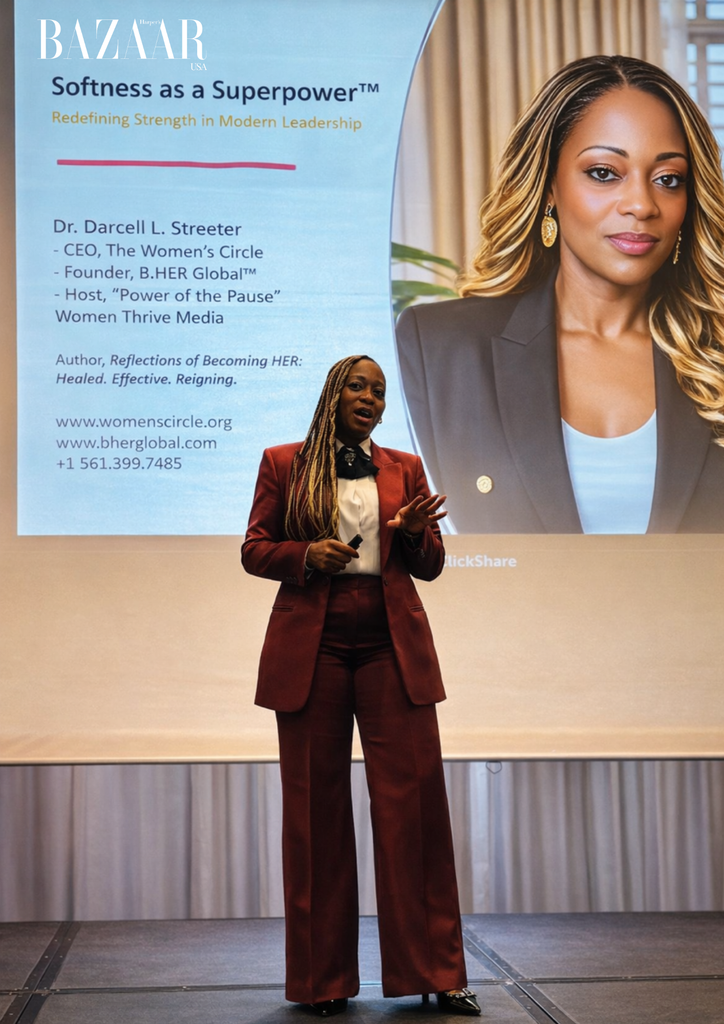
This philosophy is reflected in Circle Pedagogy, her intergenerational and culturally responsive learning framework, as well as Softness as a Superpower and PAWS, frameworks that translate the science of pause into leadership practice.
At the heart of these ideas is a belief that rigor and tenderness do not have to compete.
They can exist together.
A learning environment can have high expectations while still recognizing the human being sitting inside it.
A leader can demand excellence without creating an environment driven entirely by pressure.
And a system can be ambitious without becoming dehumanizing.
THE POWER OF THE PAUSE
Perhaps one of the most personal elements of Streeter’s philosophy comes from her own experience.
There was a time when she approached leadership with urgency. She was productive, ambitious, and constantly moving.
Eventually, the science she had spent years studying forced her to confront something she already knew intellectually but had not fully applied to herself.
A nervous system operating under constant stress is not an ideal environment for learning.
That realization changed the way she approached both work and leadership.
She began to see capacity not as a personal feeling but as a design constraint.
The question became not simply whether something could be done, but whether it could be done from a place of wholeness rather than depletion.
This philosophy now informs the way she chooses projects.
She asks three questions.
Does the project close a meaningful gap, or does it simply fill the calendar?
Who is the work genuinely for?
And can she do it from wholeness rather than hurry?
The questions are simple, but they represent a significant departure from the culture of constant acceleration.
For Streeter, pausing is not necessarily the opposite of progress.
Sometimes the pause is the decision.
DEFINING SUCCESS DIFFERENTLY
Traditional measures of success are easy to recognize.
Awards. Publications. Recognition. International stages. Accomplishments that fit neatly onto a résumé.
Streeter has experienced those milestones and is genuinely grateful for them. But she does not consider them the most important evidence of meaningful work.
In learning science, she points to a concept called transfer.
Transfer asks whether knowledge continues to be useful after the formal learning environment is gone. Did the lesson remain months later? Can the learner apply it in a situation that was never directly covered?
For Streeter, that is where real success lives.
She is interested in what remains.
Did a woman get the job, or did she build a life she can sustain?
Is a framework still being used in rooms she will never enter?
Did an organization genuinely become stronger, or did it simply become busier?
These questions reveal a broader philosophy.
Impact is not always measured by how much attention something receives. Sometimes it is measured by what continues after the attention disappears.
THE MILESTONE THAT DOES NOT APPEAR ON A CV

For someone with significant professional recognition, Streeter’s proudest milestone is surprisingly difficult to quantify.
It is what women tell her after the work is finished.
They tell her that she is genuine. That being around her makes them feel illuminated rather than measured. That her presence creates a sense of possibility.
Streeter does not dismiss those comments as compliments.
She considers them data.
Trust, in her view, is not an accessory to learning. It is one of its conditions.
When people feel evaluated, they protect themselves. When they feel safe enough to participate, question, experiment, and make mistakes, learning becomes possible.
That makes the emotional environment of education and leadership just as important as the material being taught.
For Streeter, the real achievement is not simply building a room where learning can happen.
It is creating a room where people feel safe enough to become something they were not yet able to imagine.
LOOKING TOWARD CIRCLE FORWARD
Her vision for the future is embodied in Circle Forward, her Global Life and Learning Hub.
The concept challenges the traditional separation between education for children and education for adults.
Rather than treating generations as separate groups, Circle Forward connects K through 12 STEAM education with adult vocational development within an intergenerational learning ecosystem.
The idea is both ambitious and deeply human.
A teenager and her grandmother should not necessarily have to exist within completely separate educational worlds.
Knowledge can move in both directions.
A young person may introduce an older learner to a new coding language, while the older learner may bring practical knowledge about business, work, community, or supply chains.
Streeter does not assume that expertise belongs automatically to the oldest person in the room.
She is interested in what happens when generations learn with one another rather than simply learning beside one another.
The project is also designed with replication in mind, with regional hubs planned for West Africa, Latin America, and Southeast Asia. Its vocational pathways are intended to respond to a changing employment landscape and the growing influence of automation.
One of the most important ambitions is to create opportunities for women to access global wages without being forced to leave their communities.
That vision brings Streeter’s work back to the question that has followed her since the beginning.
Who is the system designed for?
KEEPING THE HUMAN AT THE CENTER
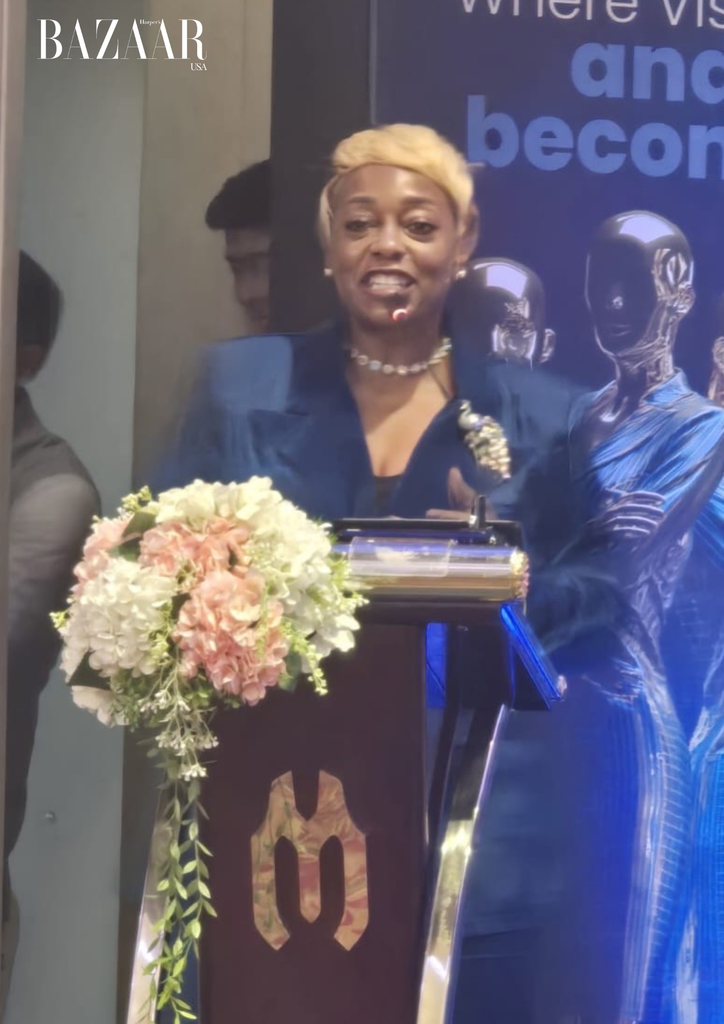
Artificial intelligence will continue to transform education, leadership, employment, and everyday life. The technology will become more sophisticated, faster, and more deeply integrated into the structures people depend upon.
But Streeter’s work suggests that technological advancement alone is not the measure of progress.
The real question is whether human beings remain visible inside the systems being built around them.
Her career began with a simple encounter at a hospital front desk. A frightened person needed help understanding a system. Streeter slowed down, listened, and made the process more understandable.
The scale of her work has changed dramatically since then.
The question has not.
Her research, frameworks, leadership work, and vision for Circle Forward all point toward the same principle. People should not have to become experts in a system before a system learns how to serve them.
In an age defined by acceleration, perhaps that is one of the most important ideas to remember.
Human beings are not machines moving through processes.
They are learners, leaders, parents, workers, teachers, creators, and communities. They carry histories into rooms. They bring different languages, experiences, strengths, fears, and ambitions with them.
Good design recognizes that.
Good leadership recognizes that.
And meaningful learning begins when the person, rather than the system, becomes the starting point.
For Dr. Darcell L. Streeter, the future of learning is therefore not simply about smarter technology.
It is about creating smarter systems without losing the human being at the center of them.
That work began twenty five years ago at a hospital front desk.
Today, it is reaching far beyond it.